Generations/History of computer:
Generations means in computer language "significant technological development that changes in hardware & software of computers", which make computer more efficient on work and reliable. We also able to call this is the evolution of computer where today's computing devices evolve from old computers, We look and understand "What the difficulties faced by computer engineers ? and how they invented new computers from old once?. This changes lead to invent different types of computers.
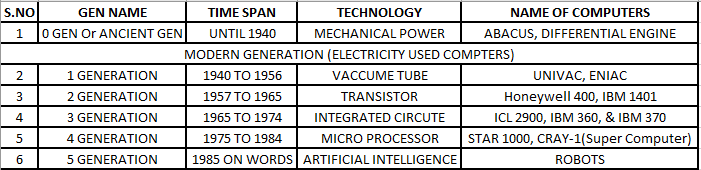
Ancient generation computers:
There is a long history detailing the invention of computers and calculating machines. The earliest recorded calculating device is the abacus. Used as a simple computing device for performing arithmetic operations, the abacus most likely appeared first in Babylonia (now Iraq) over 5000 years ago.
Charles Babbage began to construct a small difference engine in 1819 and had completed it by 1822 is named as Difference Engine 0. He announced his invention on 1822, in a paper to the Royal Astronomical Society. This machine used the decimal number system and was powered by cranking a handle.
First generation computers:
First generation used vacuum tubes as the basic components for memory and circuitry for CPU. These tubes look like electric bulbs which consume large amount of electricity and produced a lot of heat. And fail frequently. Therefore, they were very expensive and only large organizations were able to afford it.
In this generation, mainly Punch cards, paper tape, and magnetic tape was used as input and output devices.The computers in this generation used machine level programming language.

vacuum tube
Characteristics of this computers:
- Huge size
- Consumed a lot of electricity
- Generated a lot of heat
- Need of AC
- Unreliable
- Very costly
- Supported machine language only
- Slow input and output devices
- Non-portable
Second generation computers:
This generation computers work with transistors, which cheaper, consumed less power, more compact in size, more reliable and faster than the first generation machines made of vacuum tubes. In this generation, magnetic cores were used as the primary memory and magnetic tape and magnetic disks as secondary storage devices.
In this generation, assembly language and high-level programming languages like FORTRAN, COBOL were used.

Transistor
Characteristics of this computers:
- Smaller size as compared to first generation computers
- Consumed less electricity as compared to first generation computers
- Generated less heat as compared to first generation computers
- Faster than first generation computers
- Still very costly
- Reliable in comparison to first generation computers
- AC required
- Supported machine and assembly languages
Third generation computers:
The computers of third generation used Integrated Circuits (ICs) in place of transistors. A single IC has many transistors, resistors, and capacitors along with the associated circuitry. The IC was invented by Jack Kilby. This development made computers smaller in size, reliable, and efficient.
This generation remote processing, time-sharing, multi programming operating system were used. High-level languages like COBOL, ALGOL-68 etc. were used.

Integrated circuit
Characteristics of this computers: - Smaller size
- Consumed lesser electricity
- Generated less heat
- Still Costly
- More reliable in comparison to previous two generations
- Faster
- Lesser maintenance
- AC required
- Supported high-level language
Fourth generation computers:
Computers of fourth generation used Very Large Scale Integrated (VLSI) circuits. VLSI circuits having about 5000 transistors and other circuit elements with their associated circuits on a single chip is called micro processor.
This computers became more powerful, compact, reliable, and affordable. As a result, it gave rise to Personal Computer (PC) revolution. All the high-level languages like C, C++ etc., were used.

Micro processor
Characteristics of this computers:
- Very small size
- Very cheap
- Portable and reliable
- Use of PCs
- No AC required
- Concept of internet was introduced
Fifth generation of computers:
In the fifth generation, VLSI technology became ULSI (Ultra Large Scale Integration) technology, resulting in the production of microprocessor chips having ten million electronic components.
This generation is based on parallel processing hardware and AI (Artificial Intelligence) software. AI is an emerging branch in computer science, which interprets the means and method of making computers think like human beings. All the high-level languages like C and C++, Java, .Net etc., are used.
Characteristics of this computers:
- Robotics
- Neural Networks
- Game Playing
- Development of true artificial intelligence
- Development of Natural language processing
- Advancement in Parallel Processing
- More user-friendly interfaces with multimedia features
- Availability of very powerful and compact computers at cheaper rates
Nicely done. Great job buddy. 👍🏻
ReplyDeleteThis comment has been removed by the author.
ReplyDeleteDiagrams important AAA. Sir
ReplyDeleteRails is basically a web application framework, which is consist of everything needs to create database baked web application. It helps the developers to create websites and applications by providing structures for all codes written by them. Moreover, common repetitive tasks are simplified with the help of this technology.
ReplyDeleteruby on rails software house
Popular rails gems and APIs
Websites made with ruby
Best ruby gems 2019
React native and React Js
Node Js and React Js